
At Growffic, we partnered with the market leader in reverse logistics – a company that built its position through years of operational depth and trust with India’s biggest ecommerce platforms.
But their website was not reflecting that position in organic search. Many of their service-line keywords were sitting on page three or beyond, and several high-intent terms were not ranking at all.
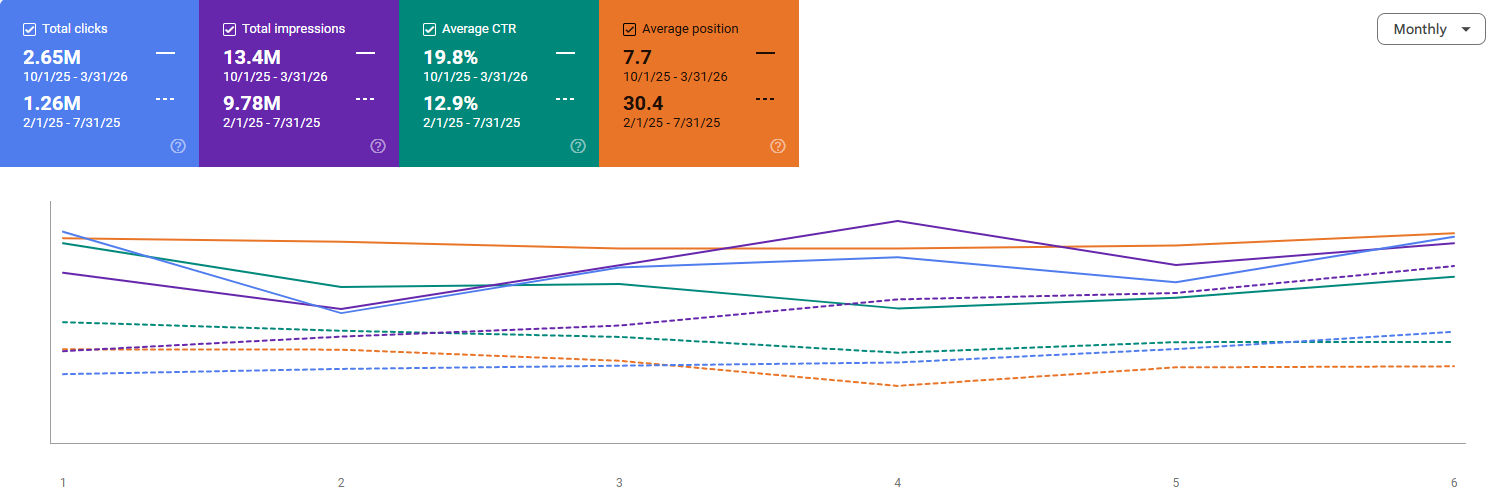
After six months of engagement covering technical SEO, content, and link building, their organic clicks had grown from 1.2 million to 2.6 million (a 110% increase). The brand’s average Google ranking climbed from page 3 to the top 10, with many key search terms ranking in the top 8 positions.
This case study breaks down exactly how we did it from the technical audit through to link building and content.
About the Client
Our client is one of India’s largest logistics and last-mile delivery platforms.
Their services cover ecommerce and D2C delivery, hyperlocal and quick commerce, SME courier, reverse logistics, same-day and next-day delivery, heavy parcel handling, and critical logistics.
They serve marquee clients, including Flipkart, Meesho, Myntra, Nykaa, Ajio, Uber, Purplle, and leading D2C brands.
For all their scale and client list, their organic presence did not reflect their real market position.
Challenges Faced
When the client first engaged us, the problems were visible.
Service pages were under-optimised, the blog had little topical coverage, and technical issues were holding back whatever rankings the site did manage to earn.
The requirement was clear: fix the technical SEO base, close the visibility gap across under-performing service lines, and build the authority needed to hold those rankings long term.
There was also a hard deadline driving the work. The client was preparing for an IPO on the Indian stock exchange and needed their organic presence to match their competitors before the listing went live.
Our Approach
1. Technical SEO Audit
We ran a full site audit covering 300+ checkpoints across crawling, indexing, content, backlinks, and site health.
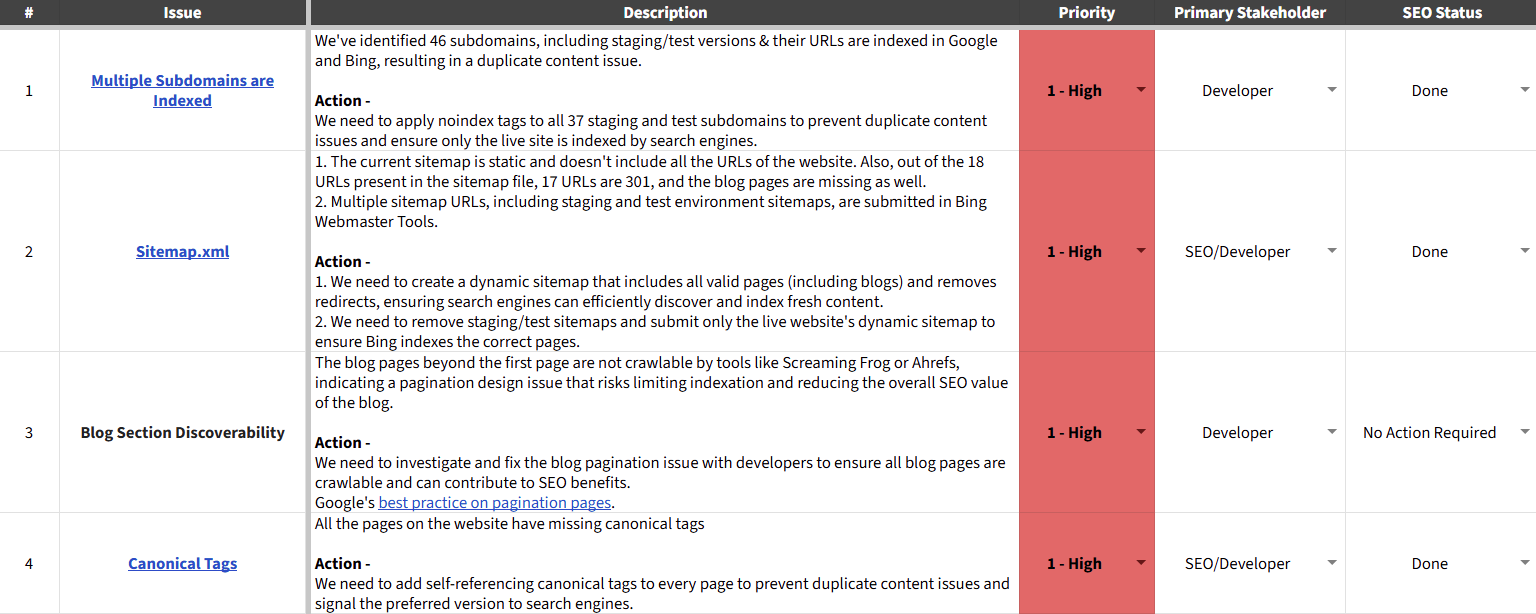
We identified the issues, prioritised them as high, medium, and low, and turned the findings into a live checklist that the client’s development team could work through.
Over the following months, we worked alongside their developers to fix the issues in sequence. High priority first, then medium, then low.
Key issues included:
- Incorrect pagination on blog listing pages, resulting in orphaned blog content
- Outdated static sitemap not aligned with the current site structure
- Missing canonical tags across service pages
- Missing schema markup on key page types
- Staging sites indexed by Google, diluting crawl budget and authority
2. Keyword Research for New Service Landing Pages
With the technical fixes underway, we moved to keyword research for service pages.
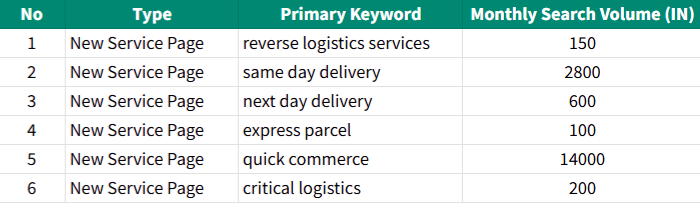
We identified which of the client’s service lines did not have dedicated landing pages, and which existing pages were targeting the wrong keywords.
This research became the basis for nine new service page briefs:
- Reverse logistics
- Same-day delivery
- Next-day delivery
- Express parcel
- Ecommerce shipping
- Critical logistics
- Hyperlocal delivery
- Quick commerce
- Courier delivery
We also recommended creating city-level courier delivery pages (e.g., Courier Delivery in Mumbai, Courier Delivery in Delhi) using a programmatic SEO approach.
3. Keyword Research and Content Gap Analysis for New Blog Pages
In parallel, we ran keyword research and a content gap analysis for the blog.
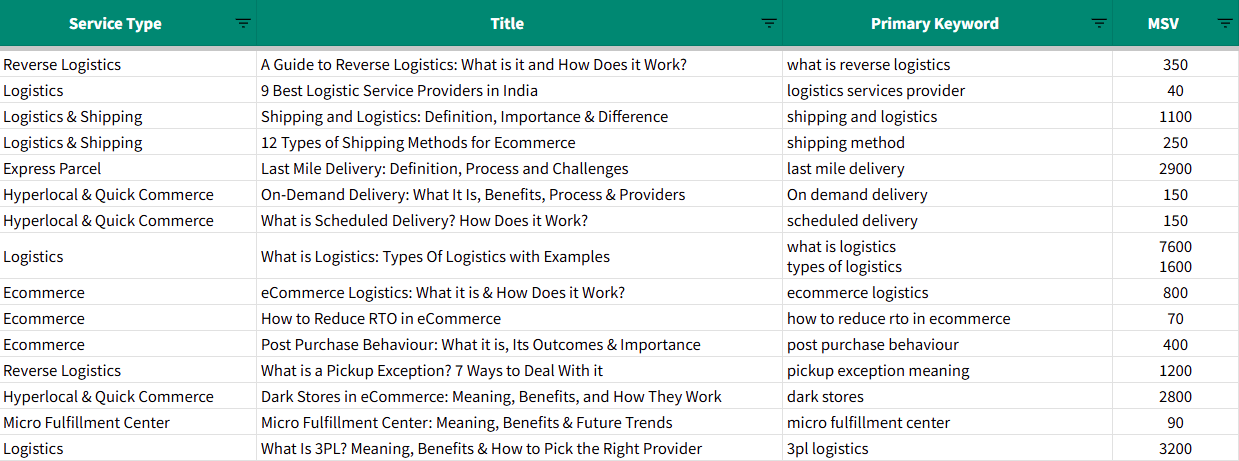
We identified content gaps by comparing customer searches against competitor rankings.
The output was a prioritised blog calendar covering reverse logistics, last mile delivery, 3PL, dark stores, micro fulfilment, quick commerce, AI in logistics, EV fleet management, and other core logistics topics.
4. Blog Content Creation
Each blog started with a detailed content brief covering target keywords, search intent, competitor benchmarks, word count targets, and internal linking instructions. Our team wrote every piece, and each article went through editorial review before publishing.
Over the course of the engagement, 50+ blogs were published, each targeting a specific keyword cluster and building the client’s topical authority across the logistics space.
5. Link Building
The client was already an established brand with strong domain authority, so the goal was not to build authority from zero.
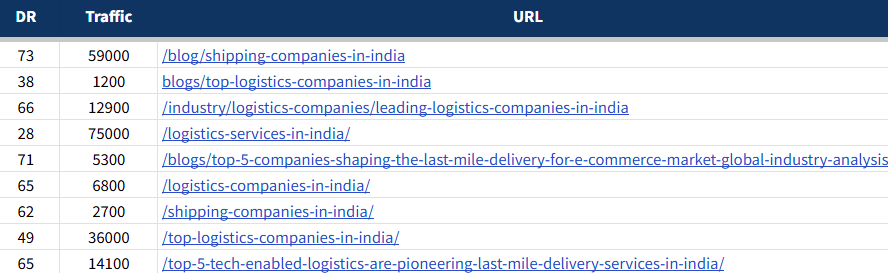
It was to direct our link building efforts towards getting the client mentioned on the AI platforms such as ChatGPT, Perplexity, and Google’s AI Overviews.
We knew from industry research that listicle articles are the single most cited content format by LLMs, accounting for roughly 50% of top AI citations.
So we identified listicle pages where the client was not yet mentioned – pages like best shipping companies in India for ecommerce and secured placements on the ones where it made sense.
Every placement gave the client a foothold in the pages that LLMs pull from when someone asks for the best last mile delivery partner in India. The client started appearing in AI-generated answers, not just traditional search results.
Alongside the listicle campaign, we built an active presence on Reddit and Quora. Wherever a relevant question came up, whether someone was asking about last mile delivery options or reverse logistics providers, we responded with helpful answers and mentioned the client where it added genuine value.
6. Weekly Meetings and Monthly Reporting
Throughout the engagement, we maintained weekly sync calls with the client’s team and delivered monthly performance reports with bi-weekly keyword ranking updates.
Results Achieved
We compared the six months before the engagement began (February to July 2025) against six months into the engagement (October 2025 to March 2026), excluding the initial ramp-up months of August and September.
All numbers are from Google Search Console.
- Organic clicks: +110% (1.26M to 2.65M)
- Impressions: +37% (9.78M to 13.43M)
- Average CTR: 12.92% to 19.77% – a 53% increase, reflecting stronger title tags, meta descriptions, and page-one visibility
- Average position: 30.37 to 7.73
Below are several high-volume keywords we tracked throughout the engagement.
Tracked Keyword Movements (Sep 2025 to Apr 2026)
| Keyword | Search Volume | Starting Position | Current Position |
| last mile delivery | 2,700 | 99 | 7 |
| ecommerce shipping solutions India | 250 | 80 | 7 |
| logistics service | 250 | 51 | 7 |
| courier services in India | 500 | 31 | 6 |
| courier service for ecommerce | 40 | 30 | 4 |
| instant delivery | 2,200 | 28 | 6 |
| same day delivery | 3,000 | 26 | 8 |
| e-commerce courier service | 30 | 26 | 2 |
| next day delivery | 450 | 18 | 8 |
| critical logistics | 200 | 13 | 7 |
| hyperlocal deliveries | 20 | 11 | 1 |
| quick commerce delivery | 90 | Not Ranking | 1 |
| express delivery | 2,700 | Not Ranking | 2 |
| express courier service | 1,400 | Not Ranking | 2 |
| best courier service in India | N/A | Not Ranking | 3 |
| last mile delivery service | 150 | Not Ranking | 4 |
| reverse shipping | 20 | Not Ranking | 4 |
The client’s service pages and blog content are now competing on page 1 across the core logistics categories, including several high-intent terms that were not ranking at all when the engagement started.
Conclusion
Through a focused SEO approach combining a technical audit, blog content strategy, link building, and continuous monitoring, Growffic helped a leading Indian logistics brand more than double its organic click volume and pull average rankings to under 8 in six months.
Even category leaders with strong brands need a steady SEO investment to be found by the right buyers in Google, in AI-generated answers, and across the platforms where purchase decisions are shaped.
If your logistics, ecommerce, or B2B business has a real-world scale that isn’t reflected in its organic visibility, Growffic can bridge the gap.
We offer Organic SEO services and Generative Engine Optimization services to ensure you dominate both traditional search and AI-driven discovery.
See more of our work on the Growffic case studies page.