
Most buyers of heavy construction equipment start their search on Google. If your listings don’t show up, the enquiry goes to someone else.
Our client, a heavy equipment marketplace in India, had just launched a brand new website. Impressions and clicks were near zero. The goal was straightforward: make organic search a real source of traffic and enquiries.
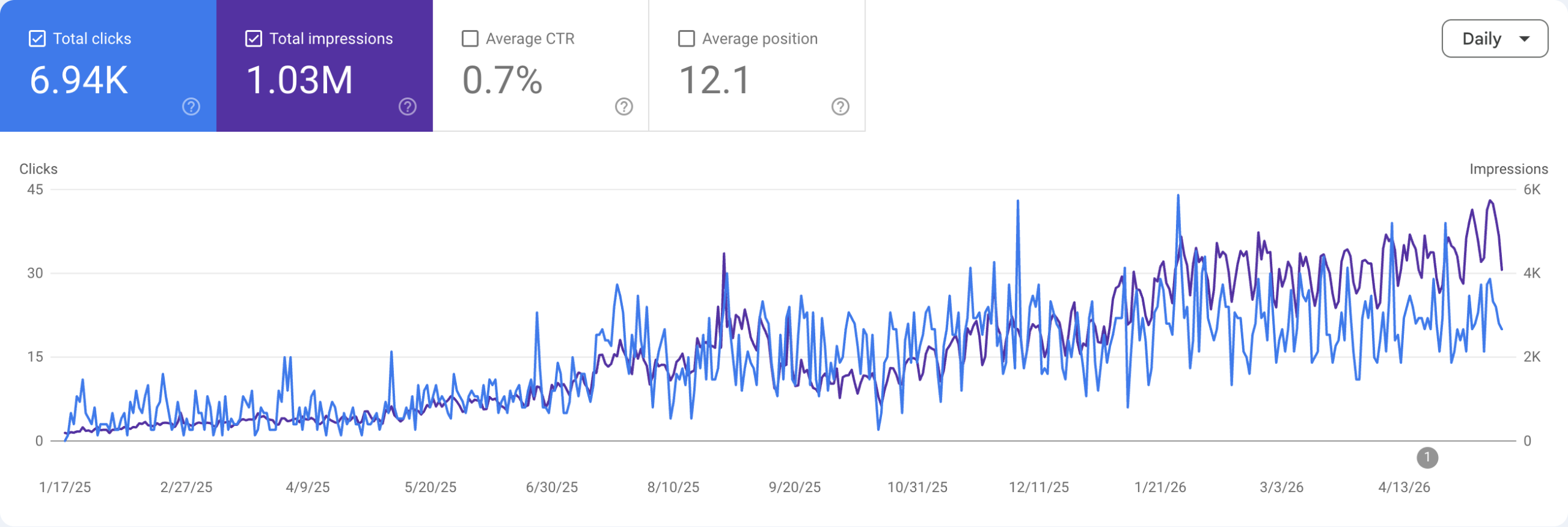
Over 16 months, organic impressions grew from nearly zero to 129K per month (913K total), and clicks went from around 30 to over 650 per month, a 20X increase. This was built from scratch on a new domain with no prior SEO work.
About the Client
The client operates an online marketplace for heavy construction equipment in India. The platform connects buyers, sellers, and rental providers across new machines, used machines, and rental inventory.
The catalogue covers 20+ OEM brands and 9+ equipment categories: backhoe loaders, excavators, cranes, dozers, dump trucks, motor graders, wheel loaders, forklifts, skid steer loaders, and roller compactors. In total, the site hosts thousands of heavy equipment product pages, each with specifications, pricing enquiry options, and dealer information.
Starting Point
The website was brand new. No SEO had been done before our engagement. Here is what we were working with:
- Technical issues were affecting crawling and indexing
- Category pages had missing or weak meta titles, descriptions, H1s, and body content
- Product and model pages had no structured on-page optimization
- No blog content existed, which meant zero top-of-funnel visibility
- Metadata was inconsistent across hundreds of pages, with duplicate or templated titles and descriptions
- Internal linking between brand, category, and model pages was weak
- Schema markup was missing across key page types
- Keyword targeting was not mapped, so high-intent searches like specific brand and model queries had no dedicated landing pages
In short: a large catalogue with thousands of pages, but no SEO foundation to make any of it visible on Google.
Our Approach
This was a budget-conscious engagement with a defined scope.
The foundational work was phased across the first 9 months to fit within the client’s budget. With a larger scope, this phase could have been compressed significantly.
Months 1-9: Building the Foundation
Technical SEO Audit and Fixes
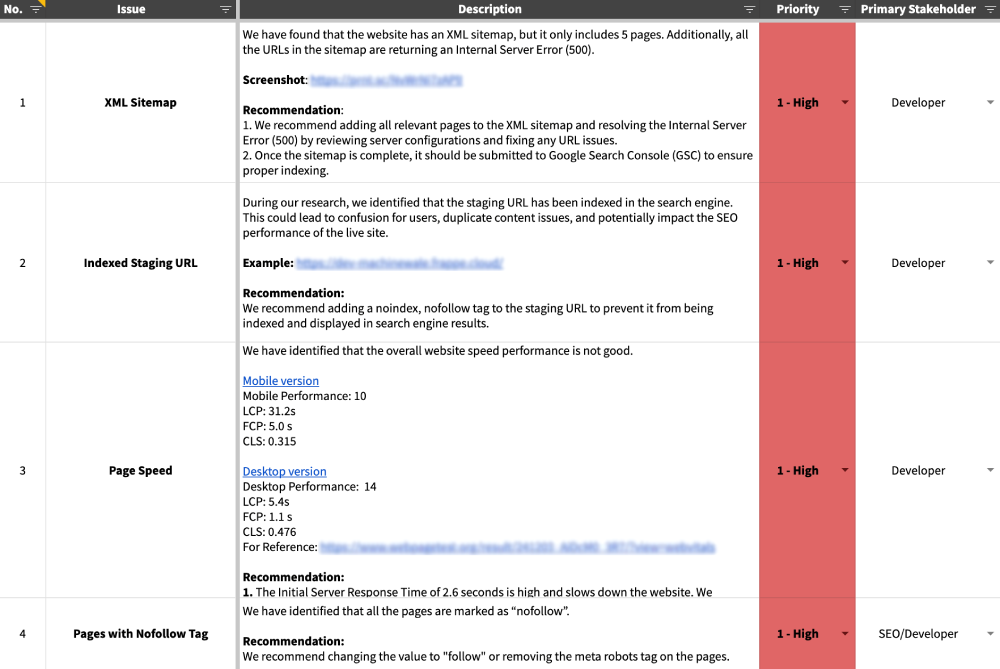
We started with a full technical audit and created a prioritised checklist of issues. High-impact items were resolved first, including indexed staging URLs, missing XML sitemaps, page speed issues, nofollow tags on pages that should have been followed, duplicate H1/H2 tags, and index bloat.
Some of the key issues we fixed:
- Indexed staging URLs
- XML sitemap not found
- Page speed
- Pages with nofollow tags
- Multiple and duplicate H1 and H2 tags
- Index Bloat
- JS Rendering Issue
Fix Technical Blockers
Crawl errors, slow load speeds, broken schema, and indexation gaps cost you visibility every single day. Our technical SEO audit pinpoints every issue and gives you a clear, prioritized fix list.
Keyword Research and Metadata Optimization
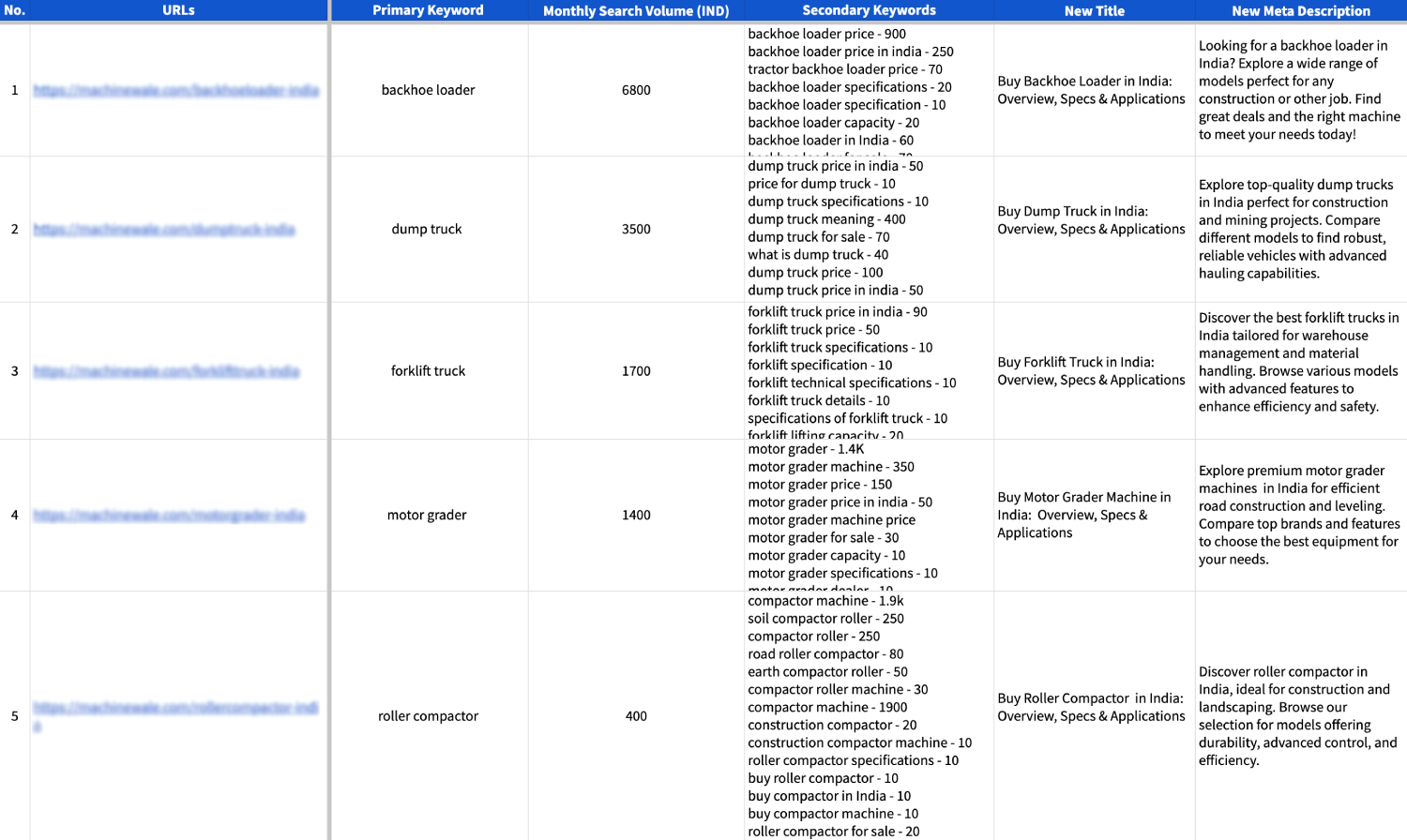
We mapped primary and secondary keywords for all category pages and key product pages. Based on this, we optimized meta titles, descriptions, and H1 tags across the site.
A key finding during this phase: product pages (individual model pages) had stronger ranking potential than category pages for this type of site. Buyers searching for specific models, e.g., “JCB NXT 140 excavator,” were landing on product pages, not category listings. This shaped our optimization priorities going forward, with particular focus on price-intent keywords at the model level.
Category Page Content
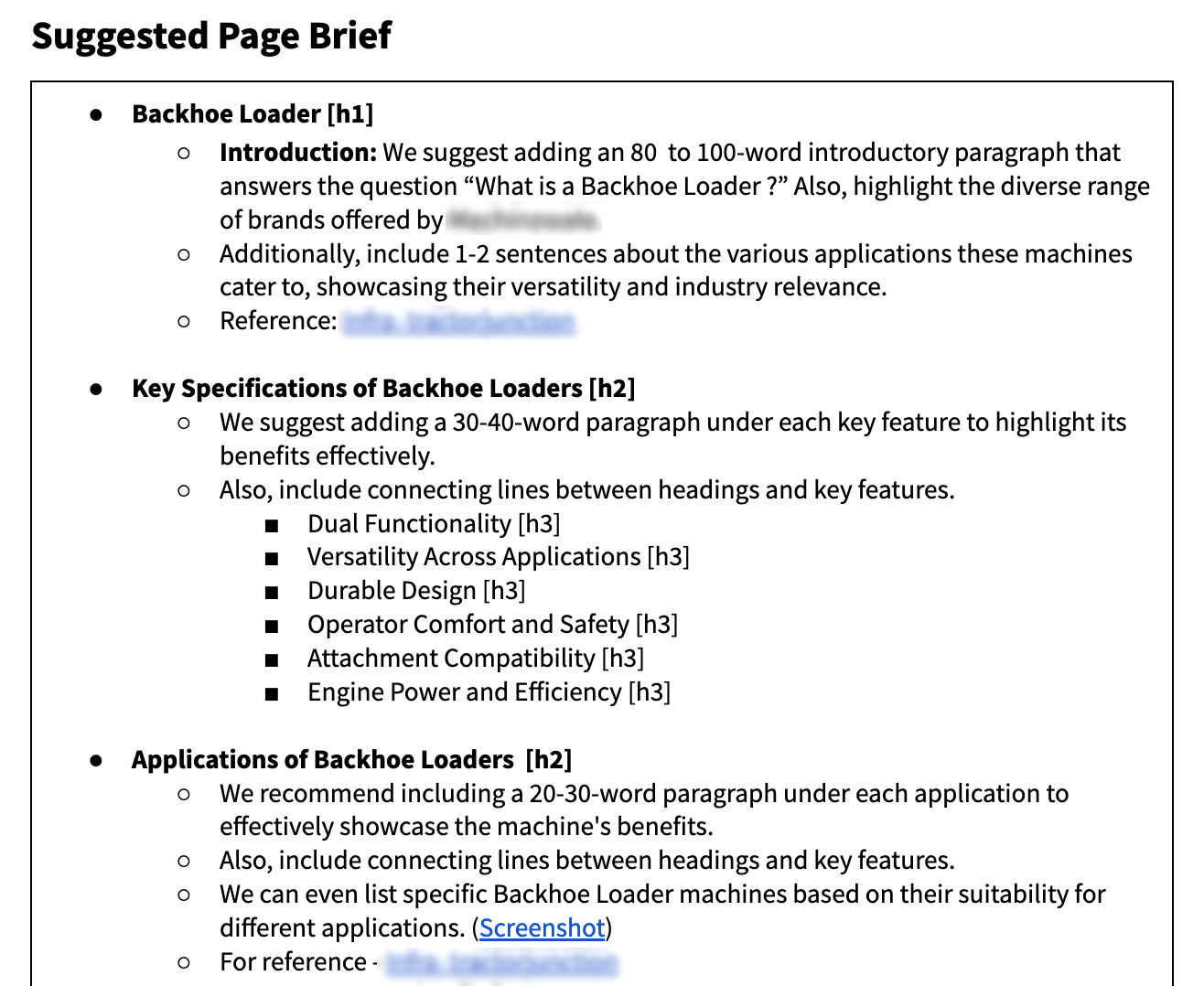
Most category pages had thin content. We created detailed content and design recommendation documents for all 50+ categories, giving the client a clear brief for each page.
UI/UX Recommendations
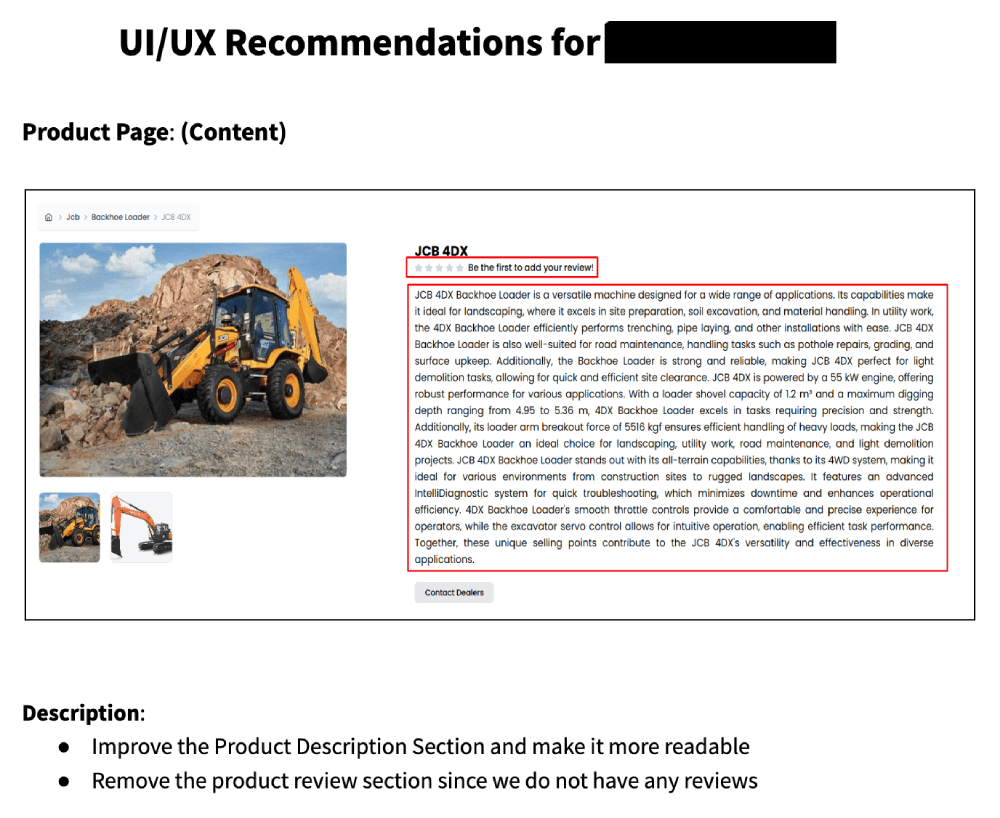
We shared recommendations covering navigation, page layouts, category structure, filters, and enquiry forms to improve both user experience and crawlability.
Months 11-16: Content-Led Growth
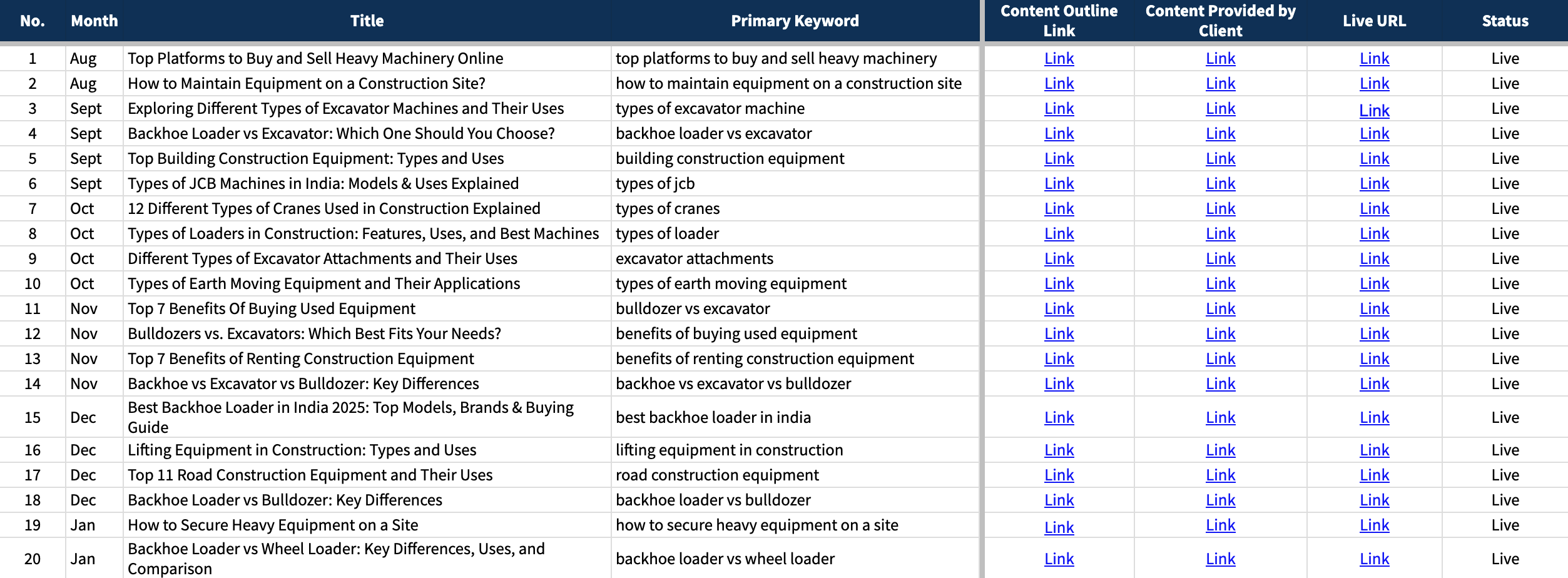
Once the foundation was in place, we shifted to content production. This is where the traffic curve started to move.
We published 22 blog posts over the final six months, each mapped to a set of target keywords and internally linked to relevant category and product pages. The blogs served two purposes: capturing top-of-funnel informational searches and building internal link equity to the commercial pages.
The effect was visible in GSC almost immediately. Blog content brought in new impressions and clicks, while the foundational work from months 1-10 meant the commercial pages were ready to convert that growing authority into rankings.
Link Building
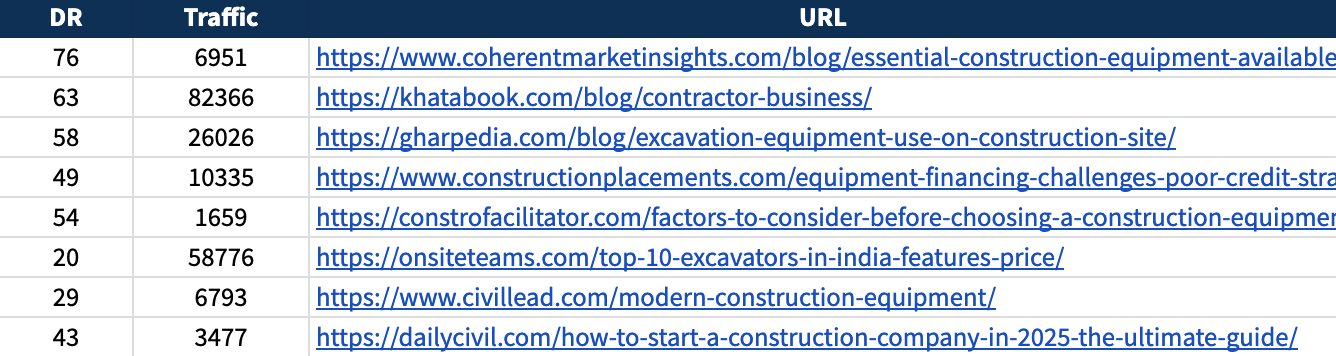
We started with a competitor backlink analysis. Most competitors had a high volume of low-quality backlinks but very few strong ones. This told us that in this niche, a small number of quality backlinks could make a real difference.
Over 16 months, we built 8 quality backlinks with an average DR of 49 and an average referring site traffic of 24,000. The focus was on contextual link inserts within existing, relevant articles rather than volume. Links were placed in articles covering topics like construction equipment rentals and excavator comparisons in India, pointing to the client’s key category and product pages.
We built backlinks following strict quality guidelines (detailed in our guide on backlink types to avoid) and focused on relevance and domain quality over volume.
What Actually Moved the Needle?
Two things drove the majority of the results:
1. Product Page Optimization
The site has thousands of model pages. By optimizing these for “[brand] [model] price” and similar high-intent queries, we unlocked traffic from buyers actively comparing machines. Optimising product and category pages at this scale is the core of ecommerce SEO, where the catalogue itself becomes the ranking asset.
For example, the JCB NXT 140 Excavator page was not ranking at all before our engagement. After optimization, it reached position 7 for “jcb nxt 140 excavator,” a keyword with 800 monthly searches in India. This pattern repeated across dozens of model pages.
2. Blog Content
The 22 blogs published in months 11-16 drove the most visible traffic increase. With the technical and on-page foundation already in place, the content had a clear path to index, rank, and pass link equity to commercial pages.
Results
Over 16 months of consistent work across technical SEO, on-page optimization, content, and link building, organic search went from near-zero to a growing channel for the marketplace.
- Total organic impressions: 913K
- Total organic clicks: 6,440+
- Monthly clicks grew from ~30 to 650+ (20X increase)
- Product pages ranking for high-intent, model-specific keywords
- Blog content driving consistent top-of-funnel traffic
Key Takeaway
For large catalogue websites, the sequence matters. Technical fixes and on-page optimization create the foundation, but content is what accelerates the growth curve. In this case, 10 months of foundational work set the stage, and 6 months of blog content turned it into visible, compounding traffic growth.
Build High-Value Search Traffic
Stop relying on paid ads that drain budget the moment you pause them. Our organic SEO services build compounding rankings, qualified traffic, and revenue that keeps growing month after month.