
Search is undergoing its biggest shift since Google launched.
Instead of 10 blue links, users are increasingly turning to AI assistants like ChatGPT, Perplexity, and Google AI Overviews for direct, summarized answers.
This evolution has sparked a new discipline: Generative Engine Optimization (GEO) – the practice of making your brand visible inside large language models (LLMs).
And it’s not a fringe trend.
A 2025 Ahrefs study of 3,000 websites revealed that 63% of sites already receive traffic from AI platforms, with ChatGPT driving over half of all AI referrals. In other words, brands that optimize for LLMs can open up a powerful new visibility channel.
So, how do you ensure your company gets cited in AI answers? Let’s look into the strategies that work today.
1. Build Listicle-Style Backlinks
A recent LLM citation study by Writesonic found that non-branded queries (e.g., “best HRMS software or Top Logistics Companies in India.”) are most likely to pull citations from listicles rather than from individual product pages.
Why? Because listicles serve as ready-made data sets:
- They provide a structured format (rankings, comparisons, summaries) that LLMs can easily parse and summarize.
- They reduce the AI’s “workload.” Instead of piecing together recommendations from scattered pages, the assistant can pull directly from existing “best of” lists.
Real-world experiments back this up. In client projects, we’ve seen that securing a spot in relevant industry listicles directly increased the likelihood of being cited by ChatGPT and Perplexity in their answers. These citations are then translated into referral traffic, essentially treating listicles as the new backlink goldmine for AI-driven visibility.
We’ve also seen our client website page appear in Google AI Generative Results specifically because it is included in relevant “Best Cloud Providers” listicles.
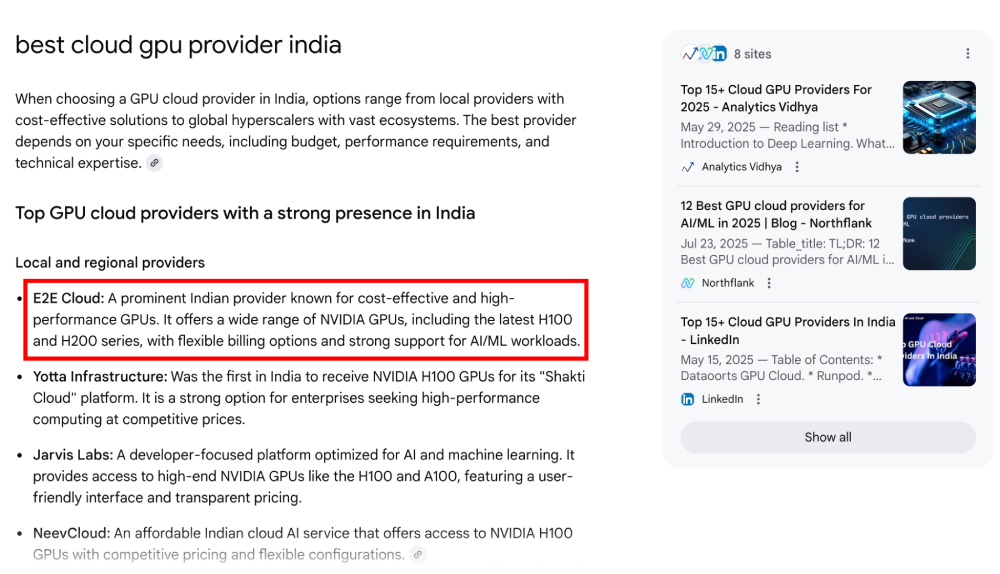
This real-world example validates how listicle-style backlinks directly influence AI citations and boost brand visibility.
Action Step:
- Identify the top “Best [Category]” articles in your niche.
- Reach out to site owners and request inclusion, ideally offering value such as updated information, a product free trial, social sharing, or providing visual assets of your product.
- It’s important to note that your service or product must be genuinely mention-worthy; otherwise, you’re unlikely to be included in any listicle.
Our link building services help brands secure placements in high-authority listicles and industry publications, which directly increases the chances of being cited by LLMs like ChatGPT and Perplexity.
2. Participate on Quora & Reddit
Large Language Models (LLMs) lean heavily on community-driven Q&A platforms like Quora and Reddit when generating responses.
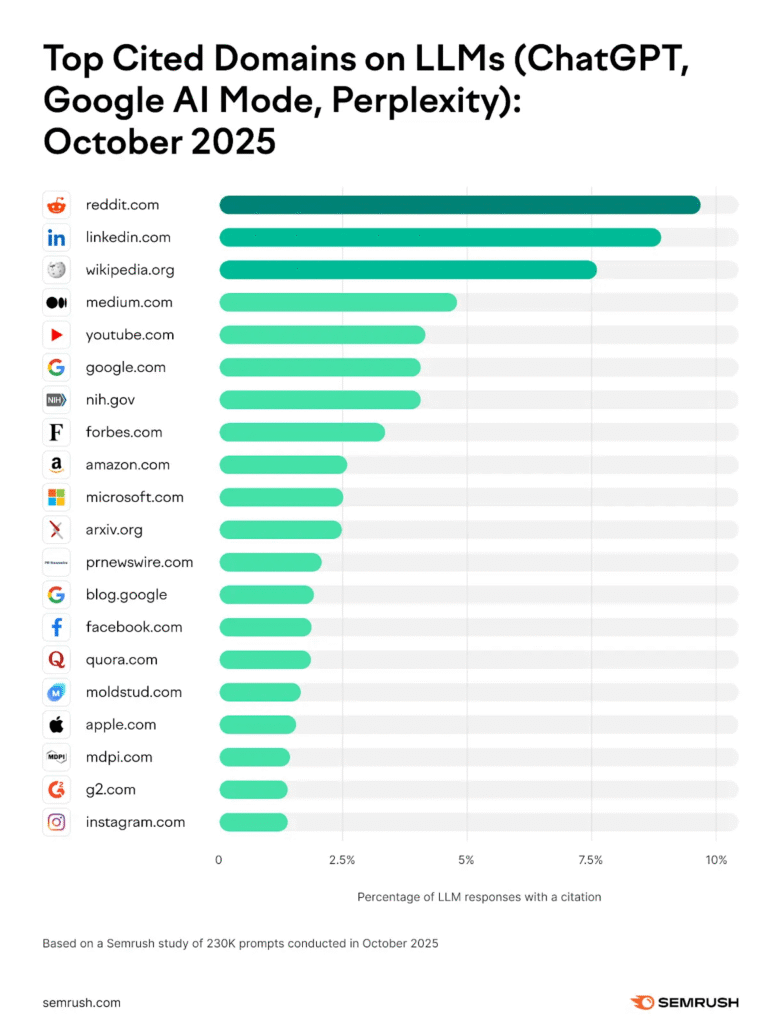
These platforms act as rich repositories of real-world user experiences, reviews, and recommendations, exactly the kind of data AI assistants want to summarize for searchers.
In fact, multiple studies confirm their influence:
- Ahrefs’ LLMO report shows that Reddit and Quora are consistently among the top-cited sources in AI answers
- A Business Insider analysis found that Google’s AI Overviews frequently cite Quora and Reddit, with Reddit emerging as the second most-cited source overall.
- A Times of India report showed that Reddit now accounts for 40.1% of citations in AI search results, surpassing even Wikipedia and YouTube.
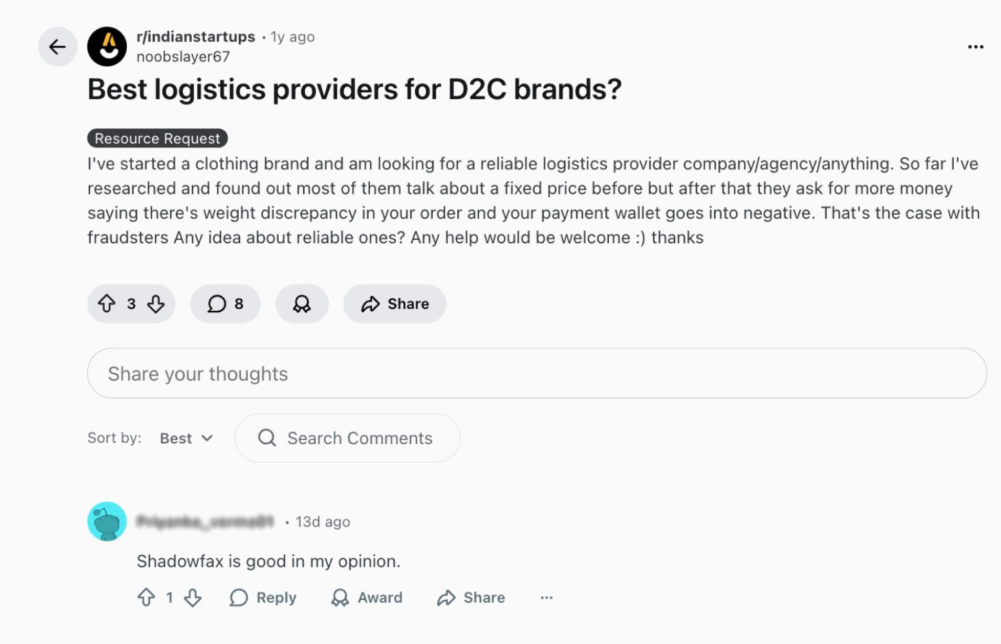
Here’s an example screenshot where our client was mentioned within a Reddit discussion. This type of user-generated content is exactly what LLMs often cite in their responses.
Action Step:
- To take advantage of this, maintain an active presence on both platforms.
- Share thoughtful, helpful answers to relevant questions, and where appropriate, mention your brand.
When users search queries like “best logistics company in India”, there’s a strong chance LLMs will surface insights not only from listicle articles but also from Reddit threads and Quora discussions.
By building a footprint on these platforms, you increase the likelihood that AI assistants will cite your brand as part of their answers.
3. Create Specific Content Formats
Not all content performs equally well in LLMs. From our experiments, the following formats tend to have a stronger influence:
- Listicles – “10 Best [Industry] Companies” (example)
- Comparison Articles – “[Your Brand] vs [Competitor]” (example)
- Review Articles – “[Your Brand] Reviews & Ratings” (example)
- GPT Articles – Read more
Most of us are familiar with the first three formats, but GPT Articles are still a relatively new approach to blogging. As described by Mint Copywriting Studios, GPT Articles are short, direct pieces created to target a specific prompt or search intent you want to rank for in LLMs.
These formats give AI assistants the context they need to understand your brand’s strengths and relevance.
Action Step:
Publish listicles, comparisons, reviews, and GPT-style content to increase your chances of being cited by LLMs.
4. Experiment with LLMs.txt
The SEO community has been buzzing about the idea of an llms.txt file similar to robots.txt, designed to guide AI crawlers like GPTBot or PerplexityBot.
However, the evidence so far shows it has little real-world effect. In a 2025 audit of 1,000 Adobe Experience Manager domains, Flavio Longato found that none of the major AI crawlers (OpenAI’s GPTBot, Anthropic’s ClaudeBot, PerplexityBot, etc.) actually requested the llms.txt file. Instead, nearly all requests came from Googlebot and a handful of SEO tools.
So why isn’t it used?
- The spec is unofficial, and no major LLM provider has committed to honoring it.
- Most LLMs rely more on pre-built datasets (like Common Crawl) than live crawling.
- AI bots already respect robots.txt, which remains the primary control mechanism.
Action Step:
- Even though adoption is limited today, we recommend adding an llms.txt file if it’s easy for you to implement.
There’s so much noise and experimentation around it that it’s worth being early, especially since standards may evolve quickly as AI crawling matures.
5. Ensure LLMs Can Crawl Your Website
AI crawlers are not as advanced as Googlebot in rendering JavaScript.
According to Vercel’s crawler study, ChatGPT’s GPTBot and Anthropic’s Claude do not execute JavaScript, meaning they may miss client-side rendered content.
Let’s understand this with an example:
SBI Securities is one of India’s top brokerage platforms, trusted by millions for reliable and seamless investing.
However, because the website relies on client-side rendering instead of server-side rendering, ChatGPT is able to crawl only limited content, resulting in just 4 citations.
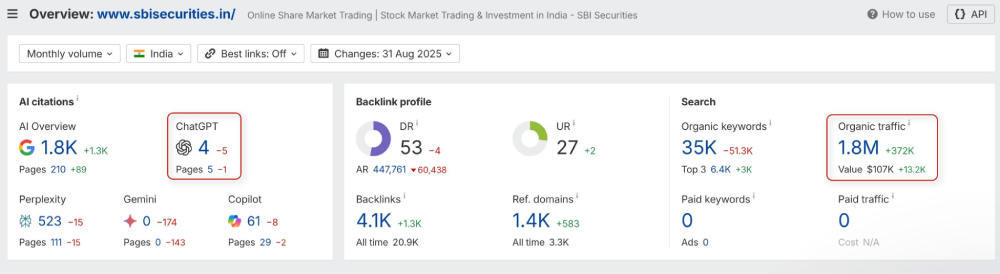
In comparison, Kotak Securities uses server-side rendering and has significantly stronger visibility with 354 citations on ChatGPT.
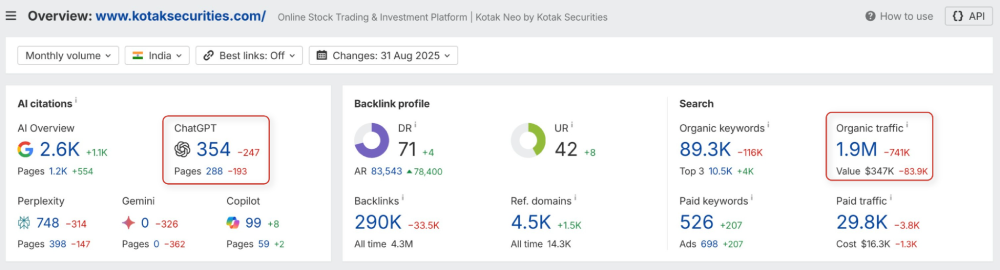
This indicates that ChatGPT struggles to crawl and index JavaScript-heavy websites compared to SSR-driven sites.
In contrast, Google Gemini utilizes Googlebot’s infrastructure, giving it full rendering capabilities.
Action Step:
- Use server-side rendering (SSR) or static HTML for critical pages.
- Keep sitemaps clean and no redirects to avoid wasted crawl budgets.
If your site is built on React, Next.js, or similar frameworks, this step is essential to ensure LLMs can access your core content.
6. Keep Content Fresh
Do AI assistants prefer fresher content? Absolutely.
A 2025 Ahrefs study analyzing 17 million AI citations found that LLMs cited content that was, on average, 25.7% fresher than Google’s organic search results, with ChatGPT showing the strongest preference.
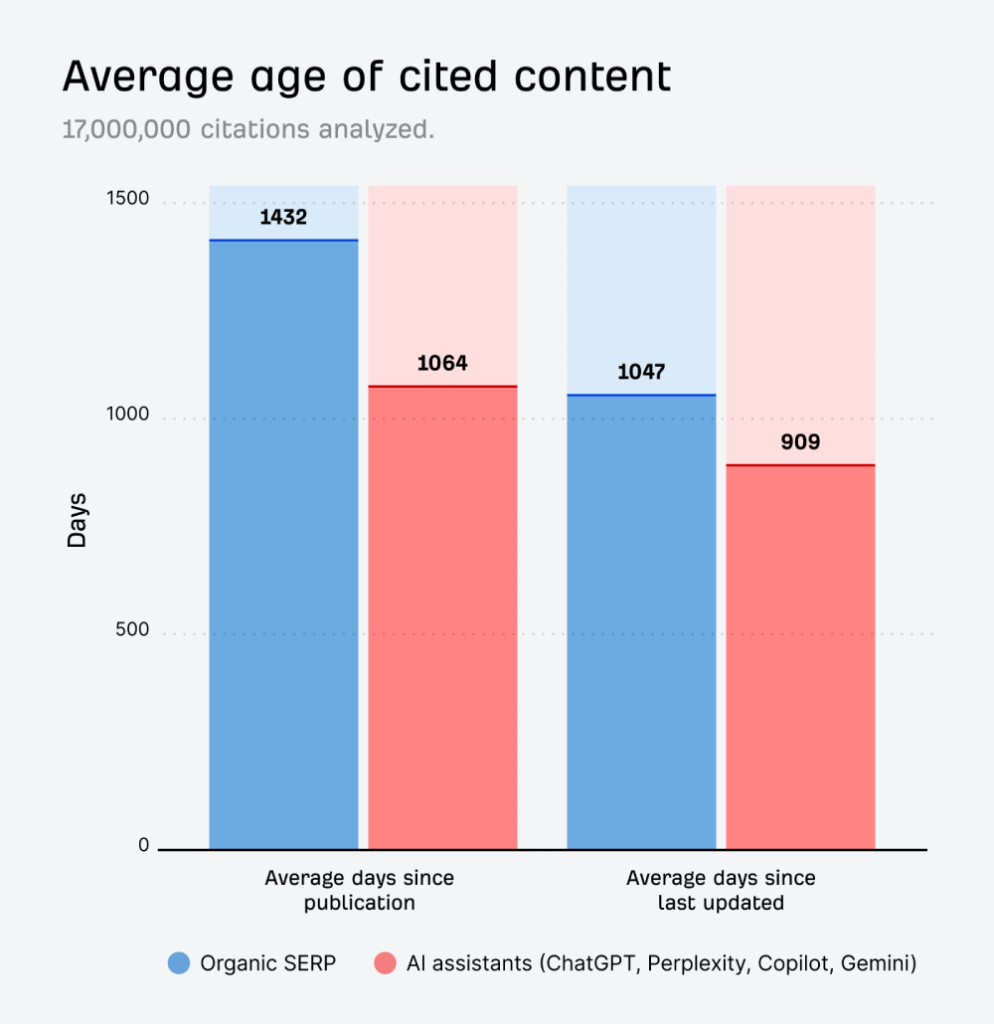
But what does “fresh” really mean in this context?
- According to the study, AI assistants typically favor content that is 0 to 1,000 days old, equivalent to about 0 to 3 years.
- Articles older than that are significantly less likely to appear in AI answers.
- “Freshness” isn’t only about the publication date. Updates, rewrites, and even re-validating stats or examples can reset an article’s freshness in the eyes of crawlers and AI models.
Why does freshness matter so much for AI?
- User Trust: AI assistants aim to provide advice that feels current and reliable. Outdated information undermines credibility.
- Training Signals: Since LLMs often pull from recently crawled datasets, newer content has a higher chance of being included in their knowledge base.
Action Step:
- Audit your most important pages annually and refresh them with new stats, updated screenshots, and current insights.
- For evergreen articles, add a section like “Updated for 2025” to make the freshness visible to both users and crawlers.
- Set reminders every 12–18 months to review cornerstone content, even if only minor updates are required.
- Think of it this way, fresh content is not just good SEO hygiene, it’s becoming a ranking factor for AI citations.
7. Follow Core SEO Best Practices
It’s easy to think of Generative Engine Optimization (GEO) as something entirely new.
But at its core, LLMs are still crawlers. That means many of the same rules that helped brands succeed in Google search continue to apply here.
In fact, research shows that AI crawlers like GPTBot and ClaudeBot behave more like “Googlebot 2010” than today’s advanced search engines.
They often skip JavaScript rendering, rely on the HTML version of your site, and well-structured data to interpret your content. If your site is messy or poorly optimized, there’s a higher chance LLMs will miss critical information.
- On-page Optimization: Clear meta titles, meta descriptions, H1s, and subheadings help LLMs (and traditional crawlers) understand your topic hierarchy.
- Structured Data & Schema: Marking up reviews, product data, FAQs, and organization details makes it easier for AI systems to contextualize your brand.
- Content Accessibility: Ensure your content loads quickly and isn’t hidden behind JavaScript-heavy rendering. Server-side rendering is your friend here.
- Page Speed & Core Web Vitals: Just like with Google, slow or clunky sites risk being deprioritized by AI crawlers that have limited crawl budgets.
- Internal Linking: LLMs, like search engines, use internal links to understand the relationships between your pages and how authority flows through your site.
This isn’t just theoretical; Microsoft Bing published an article confirming that well-structured, accessible, and SEO-optimized content is significantly more likely to be included in AI search answers.
Think of it this way: SEO is the foundation, GEO is the layer on top. Without strong technical SEO, you can’t expect LLMs to crawl or cite you properly, no matter how many listicles or community mentions you secure.
Action Step:
- Treat GEO as an extension of your SEO. Run regular SEO audits, fix crawlability issues, implement schema, and keep your site technically sound. Then, build on that base with LLM-specific strategies like listicle placements, Quora engagement, and content freshness.
8. Monitor Your Presence on Bing
So far, marketers have been entirely focused on ranking on Google. But since ChatGPT also pulls results from Bing under the hood, it’s important that we monitor our Bing visibility as well. Make sure you’ve set up and actively review your Bing Webmaster account to understand how your site is performing there.
If our presence on Bing is weak, we may indirectly hurt our chances of ranking well inside ChatGPT results, too. This isn’t something that will instantly improve your rankings; it’s more of an important awareness point.
Action Step:
- Verify your domain, submit your sitemaps, and regularly check crawl insights in Bing Webmaster Tools.
Conclusion: Early Days, Big Opportunity
Optimization for LLMs is still in its early days, and there’s no definitive playbook yet. But the studies are clear:
- 63% of websites already get traffic from AI
- Fresh, structured, and credible content improves citation likelihood
- Community participation in Reddit and Quora strongly influences AI answers
- Technical accessibility (like SSR for JS sites) ensures crawlers can read your site
The opportunity is huge. Brands that act early can dominate AI-powered search in the same way early SEO adopters dominated Google.
Next Step: At Growffic, we help clients future-proof their visibility within LLMs with our Generative Engine Optimization Services. If you’re interested in GEO strategies for your brand, feel free to reach out.
