
A client recently asked us why their blog wasn’t generating traffic despite ranking on page one. The answer surprised them: AI tools like ChatGPT and Perplexity were answering their target queries directly, without sending users to any website.
That’s the new reality. Gartner projected a 25% drop in traditional search volume, and brands that don’t adapt risk becoming invisible during the moments that matter most.
AI-powered search engines are now answering queries directly, and brands that aren’t optimized for these responses are losing visibility. When someone asks ChatGPT or Perplexity a question, your content either gets cited in the answer or it doesn’t appear at all.
GEO, or Generative Engine Optimization, is the practice of optimizing content so AI tools surface and cite it in their responses. This article breaks down seven actionable strategies to help your brand earn visibility in AI-generated answers, along with the ranking factors and implementation steps that make GEO work.
This article breaks down seven actionable GEO strategies to help your brand earn visibility in AI-generated answers, along with the ranking factors and implementation steps that make Generative Engine Optimization work.
Table of Contents
- What Does GEO Stand For
- Why GEO Matters for Business
- GEO vs SEO
- 7 Essential GEO Strategies for AI Visibility
- GEO Ranking Factors
- How to Build a GEO Strategy
- Best Practices for GEO Implementation
- FAQs About GEO Strategies
- Start Building Your GEO Strategy Today
What Does GEO Stand For?
GEO stands for Generative Engine Optimization. It’s the practice of optimizing content so AI-powered search tools like ChatGPT, Perplexity, and Google’s AI Overviews cite and surface it in their responses.
Here’s where it gets confusing: “geo” also refers to geographic or location-based marketing. If you’re looking for geo-targeting or geo-fencing, that’s a completely different discipline. This article focuses specifically on Generative Engine Optimization.
The distinction matters because AI engines are becoming primary research channels. When someone asks ChatGPT “what are the best project management tools,” the AI pulls from multiple sources and constructs an answer. Your brand either gets cited in that answer, or it doesn’t appear at all.
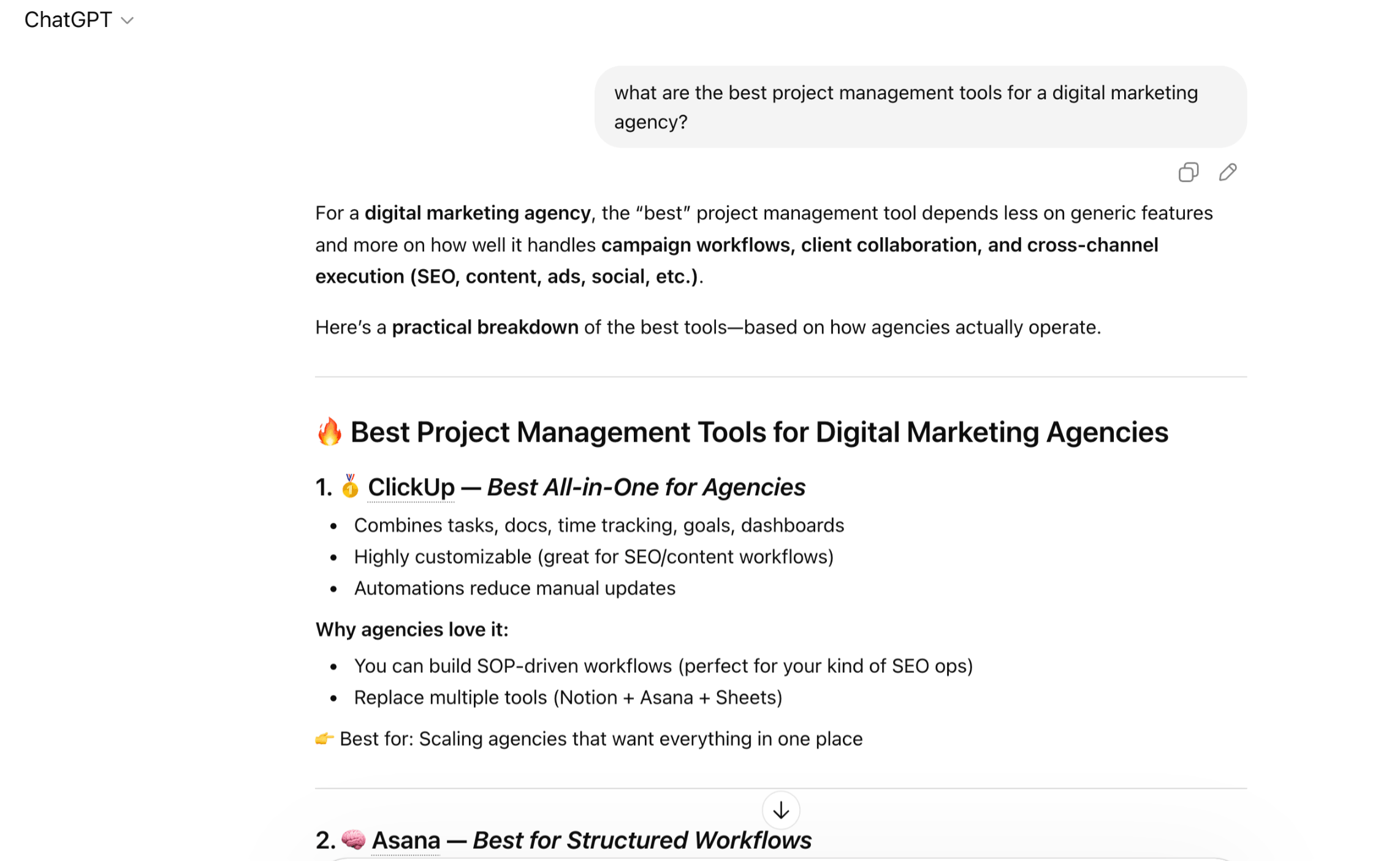
Why GEO Matters for Business?
AI tools are changing how buyers discover and evaluate solutions. 40% of B2B buyers start with AI over traditional search, and this shift has real consequences for visibility.
- Zero-click answers: AI engines provide direct responses, which means users often get what they want without visiting any website. Data on the state of organic search confirms this trend is accelerating.
- Shifting discovery patterns: Buyers are asking AI tools questions they used to type into search engines.
- Compounding authority: Brands that AI engines cite gain trust signals that reinforce future visibility, similar to how backlinks work in traditional SEO.
If your content isn’t optimized for AI citation, you’re essentially invisible during a growing portion of the buyer’s journey.
GEO vs SEO
GEO builds on SEO fundamentals but optimizes for a different output. Traditional SEO aims to rank pages on search engine results. GEO aims to get your content cited in AI-generated answers.
| Factor | Traditional SEO | GEO |
| Primary goal | Rank on SERPs | Get cited in AI answers |
| Content format | Keyword-optimized pages | Direct, quotable statements |
| Success metric | Rankings, clicks, traffic | AI citations, brand mentions |
| Target engines | Google, Bing | ChatGPT, Perplexity, Gemini, AI Overviews |
How AI Engines Process Content Differently
Traditional search engines serve a list of links. AI engines synthesize answers from multiple sources and present a single response.
Most AI search tools use a process called retrieval-augmented generation (RAG). When a user asks a question, the AI first retrieves relevant web pages, much like a search engine. It then reads through each retrieved source, extracts the most relevant passages, and synthesizes them into a single answer with inline citations.
This two-step process is what makes GEO different from SEO. In traditional search, you optimize to rank in a list. In AI search, you optimize to be retrieved as a source and to have your content selected for citation during the synthesis step. Your content could be retrieved but still not cited if it lacks clear, quotable statements.
Research from Growth Memo analyzed 1.2 million ChatGPT responses and found that 44.2% of all citations come from the first 30% of a page’s content. The AI establishes a frame from the top of your content and interprets everything else through that frame. If your key insight is buried in paragraph three, the AI will likely cite a competitor whose answer appears earlier.
This means AI engines prioritize content that is authoritative, well-structured, and factually clear. Vague or poorly organized content rarely gets cited, even if it ranks well in traditional search.
When to Prioritize GEO Over SEO
GEO and SEO work together. Strong SEO fundamentals directly support GEO performance – 76.1% of URLs cited in AI Overviews also rank in Google’s top 10.
However, GEO becomes especially important in certain situations:
- Informational queries: When someone searches “what is account-based marketing” or “how to calculate customer acquisition cost,” AI Overviews now appear above traditional results 40% of the time. If your content isn’t optimized for citation, you’re invisible even if you rank on page one.
- Competitive markets: In crowded industries like marketing automation or project management software, buyers ask AI tools “what’s the best solution for [specific use case]” before they ever visit a website. If competitors get cited and you don’t, you’ve lost the deal before the evaluation even starts.
- Thought leadership: When a prospect asks ChatGPT about a methodology or framework your brand created, being cited as the source builds immediate credibility. That single citation can influence buying decisions worth thousands or millions in contract value.
7 Essential GEO Strategies for AI Visibility
Here are the core strategies that help content earn visibility in AI-generated answers.
1. Optimize Content for Direct AI Citation
AI models favor clear, concise, and quotable statements. The key is structuring your content so an AI can easily extract a direct answer.
Structure each section so the most quotable insight appears in the first one or two sentences. AI models scan for direct, declarative statements that answer specific questions. If your key point is buried in paragraph three, the AI will likely cite a competitor whose answer appears immediately.
Test your content by asking: could an AI extract a complete, accurate answer from the opening of this section without reading further?
For example, if you’re writing about customer acquisition cost, start with: “Customer acquisition cost (CAC) is the total cost of sales and marketing efforts needed to acquire one new customer.” That’s quotable. Compare that to: “Understanding your customer acquisition metrics is essential for business growth, and one of the most important metrics to track is CAC…” The second version buries the definition, making it harder for AI to cite.
2. Strengthen E-E-A-T Signals Across Your Site
E-E-A-T stands for Experience, Expertise, Authoritativeness, and Trustworthiness. Google introduced this framework in its Search Quality Rater Guidelines, and AI engines weigh these signals heavily when deciding which sources to cite.
- Author credentials: Include detailed bios that establish expertise in the topic
- Source citations: Reference authoritative data and publications throughout your content
- Transparent methodology: Explain how you arrived at conclusions, especially for original research
3. Earn High-Quality Backlinks and Brand Mentions
Backlinks from reputable websites remain a powerful trust signal for AI models, just as they are for traditional search. Digital PR and link building help establish the authority that AI engines look for when selecting sources to cite.
Interestingly, unlinked brand mentions also contribute to AI recognition. When your brand name appears across the web in relevant contexts, even without a link, AI models begin associating your brand with specific topics.
4. Build Topical Authority Through Content Clusters
A content cluster consists of a central “pillar page” covering a broad topic, supported by multiple “cluster articles” that explore related subtopics in depth. This structure signals comprehensive expertise to AI models.
For example, a pillar page on “content marketing strategy” might link to cluster articles on content calendars, distribution channels, and measurement frameworks. Internal links connect the pillar and cluster pieces, helping both search engines and AI models understand your depth of coverage.
AI models evaluate topical depth across an entire domain, not just individual pages. When your site covers a topic comprehensively through interconnected cluster content, AI engines are more likely to treat your domain as a trusted authority for that topic.
5. Use Structured Data to Improve AI Comprehension
Schema markup is code that helps search engines and AI models understand the context of your content. Implementing specific schema types makes your content more machine-readable.
The most valuable schema types for GEO include:
- FAQ schema: Marks up question-and-answer content
- How-To schema: Structures step-by-step instructions
- Article schema: Identifies content type, author, and publish date for blog posts and articles
- Product schema: Provides detailed product information including price, availability, and reviews for e-commerce sites
- Organization schema: Provides clear information about your brand, including contact details and social profiles
- Breadcrumb schema: Shows page hierarchy and site structure
- Video schema: Helps AI understand video content, duration, and key topics
You can validate your implementation using Google’s Rich Results Test.
6. Create FAQ and Q&A Content Formats
AI engines frequently pull answers from FAQ sections because the question-and-answer format directly matches how users query AI tools. When someone asks ChatGPT a question, content structured as Q&A provides a ready-made answer.
Add dedicated FAQ sections to key service and product pages. Each question addresses a specific customer concern with a direct, concise answer, typically two to three sentences.
7. Monitor AI Platform Visibility and Iterate
Tracking AI citations is essential for refining your GEO strategy, though the tools are still emerging.
You can track AI citations manually by querying ChatGPT, Perplexity, and Gemini with your target questions and noting which sources get cited. However, for consistent tracking at scale, dedicated tools are more reliable. Platforms like Ahrefs and Semrush are adding AI visibility features, and specialized GEO tracking tools make it easier to monitor citation performance across multiple AI engines without manual checking.
GEO Ranking Factors
While AI ranking algorithms are less transparent than Google’s, testing and research have revealed key factors that influence citation likelihood.
Content Relevance and Depth
According to research published by Growth Memo, AI engines prioritize content that answers multiple related queries within a single, well-structured resource. A comprehensive comparison page covering ten software alternatives will consistently outperform ten shallow individual reviews. The key isn’t just depth on one question; it’s breadth across a topic cluster. AI models cite sources that demonstrate complete coverage of a subject, not just surface-level summaries that force users to look elsewhere for context.
Source Authority and Trust
Domain authority, backlink profiles, and overall brand recognition all influence whether AI cites your content. Lesser-known sites can compete by building stronger trust signals: expert authorship, detailed sourcing, and consistent topical focus.
Freshness and Accuracy
AI tools favor up-to-date and factually accurate content. Ahrefs’ study analyzing 17 million citations found that AI-cited content is 25.7% fresher than organic Google results, meaning AI assistants cite significantly more recent content than traditional search engines surface. Outdated statistics or incorrect claims significantly reduce citation likelihood. Regular content audits help ensure your information remains current and competitive for AI citation.
How to Build a GEO Strategy
Building a GEO strategy follows a logical sequence: audit, prioritize, and track.
Audit Your Current AI Visibility
Start by querying ChatGPT, Perplexity, and Gemini with the questions your target audience asks. Note which competitors get cited and identify gaps where your content could provide a better answer.
You can also use GEO tracking tools to audit your current visibility across AI platforms and understand how your content performs in AI-generated responses.
Prioritize High-Impact Content Updates
Focus first on pages that already rank well in traditional search but lack AI-friendly formatting. Pages with established authority often just need structural improvements.
Updates might include adding quotable definitions at the top of sections, incorporating FAQ content, and ensuring the overall structure is clear and logical.
Track Performance Across AI Platforms
GEO requires ongoing monitoring because AI models update frequently. You can build a simple tracking system manually even a spreadsheet where you log queries weekly works to understand how your visibility changes over time. However, a more efficient approach is using dedicated GEO tracking tools that automate citation monitoring across multiple AI platforms, saving time and providing more consistent data.
Best Practices for GEO Implementation
Here are tactical practices that help maximize your content’s visibility in AI answers:
- Write in clear, direct language: Avoid jargon-heavy sentences that AI struggles to parse
- Front-load key information: Place definitions and direct answers in the first sentence of sections
- Cite credible external sources: AI values content that references authoritative data
- Update content regularly: Refresh pages with new information to maintain freshness signals
- Maintain consistent brand mentions: Ensure your brand name appears naturally throughout your content
- Align with SEO fundamentals: Strong technical SEO and on-page optimization support GEO performance
Tip: When updating existing content for GEO, start with your highest-traffic pages. Pages with existing authority often yield faster results than creating new content from scratch.
FAQs About GEO Strategies
What is the difference between GEO and geo marketing?
GEO (Generative Engine Optimization) focuses on optimizing content for AI-powered search engines. Geo marketing refers to location-based marketing strategies that target audiences by geographic region. The two disciplines are unrelated but share an abbreviation.
How long does GEO take to show results?
Results vary based on existing authority and content quality. Most brands begin seeing AI citations within a few months of implementing structured, authoritative content updates. Highly competitive topics may take longer.
Can small businesses benefit from GEO strategies?
Yes. Small businesses with niche expertise can earn AI citations by creating highly specific, authoritative content in their domain. In focused topic areas, depth of expertise often matters more than brand size.
What tools help track AI citation performance?
Currently, manual queries in ChatGPT, Perplexity, and Gemini are the most reliable method. Ahrefs and Semrush are beginning to add AI visibility features, and dedicated GEO tracking tools are emerging.
Does GEO replace traditional SEO?
No. GEO complements SEO by extending visibility into AI-powered search experiences. Strong SEO fundamentals like quality content, backlinks, and technical optimization directly support GEO performance.
Start Building Your GEO Strategy Today
AI-powered search is reshaping how brands earn visibility. The shift isn’t coming. It’s already here, and the brands adapting now are building compounding advantages.
GEO builds on SEO fundamentals while optimizing for a new generation of search. The strategies aren’t complicated, but they do require intentional effort: structuring content for citation, building authority signals, and tracking performance across AI platforms.
At Growffic, we help SaaS, B2B, and growth-focused brands build visibility across both traditional and AI-powered search. If you’re ready to start building your GEO strategy, get in touch.
